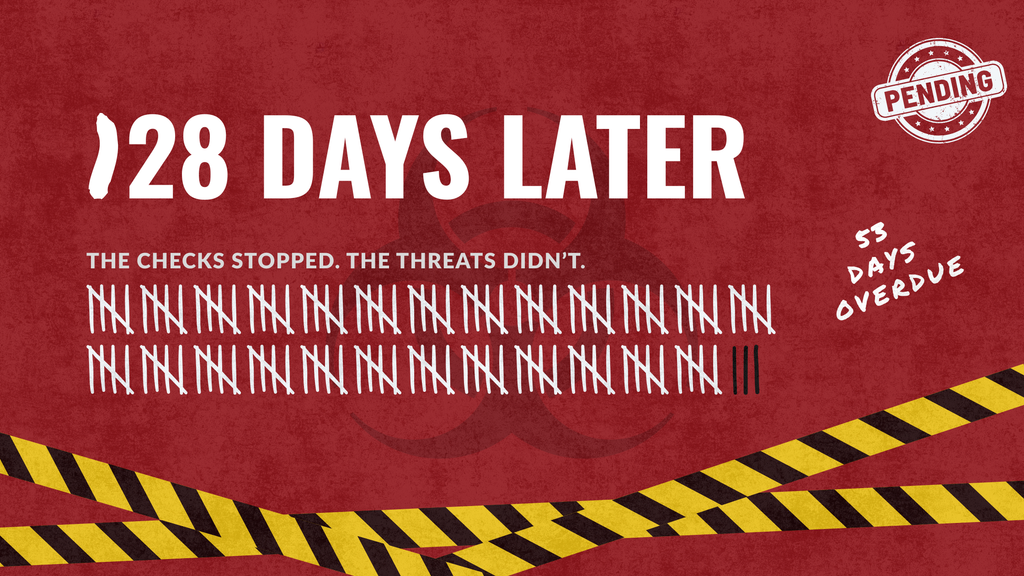
128 days into the CMMC pause, the task force report is 53 days overdue. Too many organizations are acting like CMMC is dead. The threats it was built to stop are very much alive.
November 10 Came & Went
In the classic outbreak story, someone wakes up weeks later to find the world quiet and the streets empty. For defense contractors, November 10 felt a little like that.
November 10 was supposed to be the day CMMC Phase 2 took effect. Instead, it passed quietly, with no new date, no public report, and no clear direction for the more than 80,000 companies expected to need Level 2.
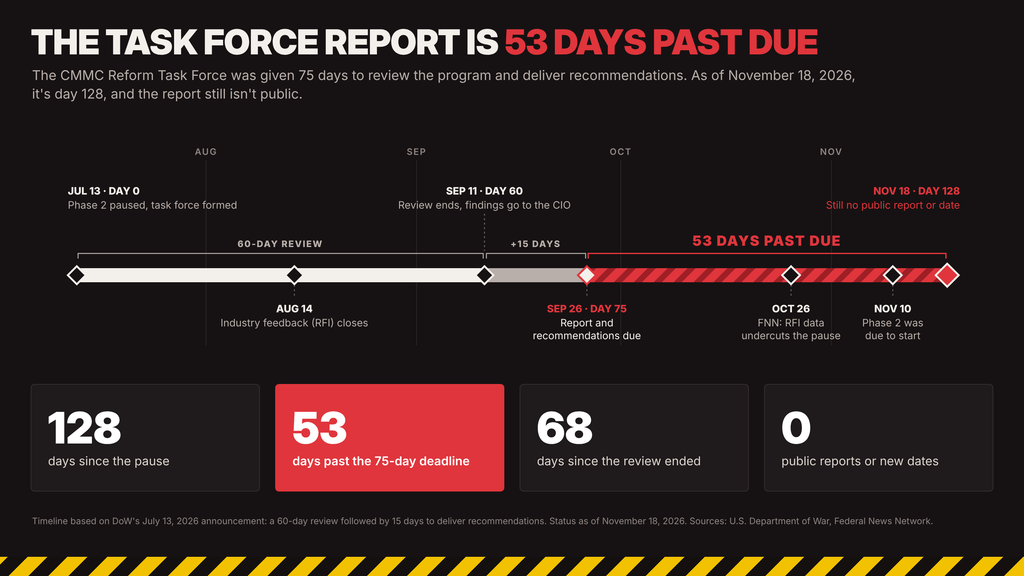
On July 13, the Department of War (DoW) suspended Phase 2 and stood up a CMMC Reform Task Force. The plan was clear: 60 days to gather feedback and review the program, then 15 days to deliver recommendations to the DoW Chief Information Officer (CIO) and the Under Secretary for Acquisition and Sustainment. That put the finish line around September 26.
Today is day 128. The report is now 53 days past due, and the 60-day review ended 68 days ago. The CIO has said the report will be made public, but no date has been set.
We’ve written a lot about the pause and the task force timeline. Now that the deadline has come and gone with nothing to show for it, it’s time to talk about what the silence is doing. Across the Defense Industrial Base (DIB), “wait and see” has quietly become “stop trying.” Many organizations are treating CMMC as if it’s dead. The threats it was built to stop are not.
The Data Didn’t Back the Pause
DoW gave three reasons for the pause: CMMC costs too much, the assessment process is too burdensome, and there aren’t enough assessors. In late October, Federal News Network’s Jason Miller published a two-part investigation based on DoW’s internal summary of industry feedback, and the data complicates all three. The biggest cost driver respondents named was meeting the NIST SP 800-171 controls themselves, which were required long before CMMC. The average reported assessment cost was about $47,000, far below public estimates as high as $600,000. And assessment capacity was never close to maxed out. DoW declined to comment.
In other words, the pause removed the independent check, not the cost of protecting Controlled Unclassified Information (CUI). FNN’s second installment describes a practical path the task force put on the table, including a narrower restart of Phase 2 within 90 days. It just hasn’t been chosen yet.
Yes, the Pause Saves Money
Let’s give the pause its due. For a contractor, no third-party assessment means no assessment fee. It also means no outside assessor second-guessing practices you already consider compliant, and no wrestling with different interpretations from assessors, primes and consultants. Those are real costs and real frustrations, and many in industry are glad to be rid of them for now.
But the assessment was never the expensive part, and it was never the risky part. Taking it away doesn’t remove the risk. It moves it.
The Risk Didn’t Go Away. It Moved.
With no assessor checking your program up front, compliance gets judged after the fact, by people with far less patience:
- Whistleblowers. Under the False Claims Act, employees and other insiders can file suit on the government’s behalf and share in any recovery. The person who knows your gaps best may already be on your payroll.
- The Department of Justice. DOJ continues to pursue contractors over cybersecurity. In June, an Alabama defense contractor agreed to pay $507,144 to resolve allegations that it hadn’t implemented required NIST SP 800-171 controls. A government assessment had scored it at -170, on a scale that tops out at 110. The pause doesn’t change that exposure.
- Incident investigations. If you’re breached, DFARS 252.204-7012 requires a report within 72 hours, preserved system images, and access for DoW’s forensic analysis. Every claim you’ve made about your program gets tested against what investigators find.
- Your own signature. A senior official still affirms compliance every year. Without a third-party certification behind it, that signature carries the full weight.
None of the obligations moved, either. DFARS 252.204-7012 still requires the 110 controls in NIST SP 800-171. DFARS 252.204-7019 still requires a current score in the Supplier Performance Risk System (SPRS). Primes still set their own requirements for suppliers. The pause changed when verification happens. It didn’t change what you’re accountable for.
The Rise of the Compliance Zombies
In every outbreak story, the danger isn’t the one you can see. It’s the one already inside the walls.
Here’s the quieter problem with the pause: almost everyone in your organization now has a reason to tell leadership ‘we’re fine’. Finance would rather not fund work no one is checking. IT is stretched thin. The business would rather not slow down for controls. And nobody is rewarded for going looking for gaps, because finding one creates work and liability. Minimal compliance and convenient ignorance become the path of least resistance.
That’s how leadership becomes a compliance zombie: still signing the affirmation every year, still believing the program is sound, and sleepwalking toward risks the organization has stopped looking for.
Meanwhile, the threat is very much alive. While the review clock has run, the warnings have kept coming, many of them aimed squarely at the defense supply chain.
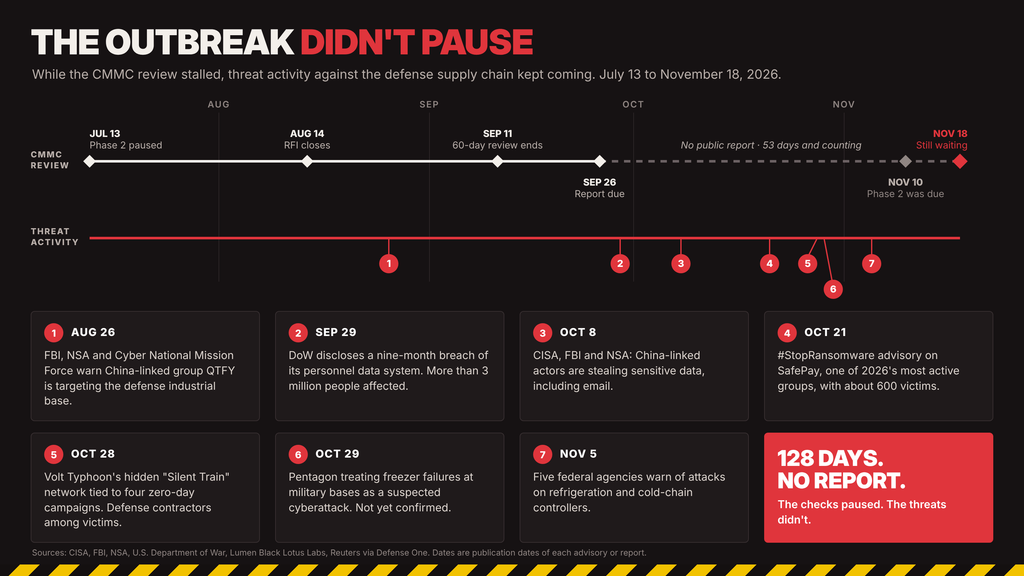
| Date (2026) | What Happened | Why it Matters to the DIB |
| Nov 5 | CISA, FBI, HHS, USDA and DOT warned of ongoing attacks on industrial refrigeration and cold-chain controllers. | Attackers are going after operational technology, the same area the DoW CIO has called a priority for manufacturers. |
| Oct 29 | Reuters reported the Pentagon is treating freezer failures at at least six military commissaries in August as a suspected cyberattack. | Not yet confirmed as an attack, but U.S. Cyber Command is part of the investigation. |
| Oct 21 | CISA, FBI and partners issued a #StopRansomware advisory on SafePay, one of 2026’s most active groups, with roughly 600 victims. | Ransomware hits small and mid-sized manufacturers hardest. |
| Oct 8 | CISA, FBI and NSA warned that China-linked actors, enabled by Integrity Technology Group, are combining botnets and hands-on hacking to steal sensitive data, including email. | Email and file data is exactly where most CUI lives. |
| Late Sept | DoW disclosed that its Defense Manpower Data Center was breached through a file-sharing flaw from October 2025 to July 2026, exposing data on more than 3 million people. | If attackers can sit inside the Department’s own systems for nine months, its suppliers are not safer. |
| Aug 26 | FBI, NSA and Cyber National Mission Force warned of China-linked group QTFY, which targets the DIB by exploiting common products such as VPNs, firewalls and file-transfer tools. | The entry points are the everyday technology small contractors run. |
Some of Them are Already Inside
The more sobering reporting isn’t about attacks that already happened. It’s about access adversaries already hold, and are holding for later.
- Volt Typhoon is pre-positioned. U.S. agencies have assessed for years that this China-linked group targets critical infrastructure not to steal secrets, but to be able to disrupt services in a future crisis or conflict. On October 28, Lumen’s Black Lotus Labs reported that the group spent three years using a hidden relay network it calls “Silent Train” to run at least four zero-day campaigns against the systems companies use to manage their networks and devices. Lumen has notified hundreds of victims, including defense contractors.
- Salt Typhoon hasn’t left. The China-linked group that broke into major U.S. telecom carriers is still active. In February, a senior FBI cyber official said the threat remains very much ongoing, and the Senate Commerce Committee has questioned whether the intruders were ever fully removed.
- The intelligence community agrees on who. The 2026 Annual Threat Assessment names China as the most active and persistent cyber threat to U.S. government, private-sector and critical infrastructure networks.
Pre-positioning is a bet on timing: get in quietly now, use the access later. Defenders don’t get to choose that date. That’s exactly why the time to verify protections is before it arrives, not after.
The Attacks are Getting Faster
Adversaries are now putting AI to work. In September, Anthropic reported that most of the malicious operations it described used AI to carry out or orchestrate the attack. They included a Russian-aligned espionage campaign against more than 20 government and defense organizations and drone component manufacturers. In one case, an intrusion went from a stolen developer token to full control of a cloud environment in about three hours.
NIST SP 800-171 Revision 2 is still the standard DoW holds contractors to, and it’s a solid foundation. But it was published in 2020, and attackers have moved faster since. Revision 3 has been final since 2024, and the task force reportedly recommended moving to it. The lesson isn’t that Rev 2 falls short. It’s that a program built only to pass a checklist won’t keep pace. Meeting the controls is the starting line. Watching for, detecting and responding to what gets through is what keeps you standing.
None of this is new in kind. Google’s threat intelligence team reported in February that the DIB faces nonstop attacks from China, Russia, Iran and North Korea, with China-linked espionage leading by volume. And CMMC itself was born from exactly this problem: years of steady theft of defense program data from contractor networks.
Survivors in these stories have one thing in common: they didn’t mistake the quiet for safety.
Keep Your Foot on the Gas
Industry can adapt to almost any reasonable outcome of the review. Until there is one, here is what we recommend for defense contractor leaders:
- Pressure-test what you sign. Before your next annual affirmation, ask for the evidence behind it, not just the assurance.
- Keep implementing NIST SP 800-171. It’s required today, and every likely outcome of the review builds on it.
- Re-check your SPRS score. Make sure it still describes your environment as it actually runs, not as it ran when you submitted.
- Patch and watch your edge. VPNs, firewalls, file-transfer tools and connected equipment are where recent campaigns are getting in.
- Rehearse your 72-hour reporting. Know who calls whom before you need to.
- Ask your primes what they expect. Many will not wait for DoW to restart Phase 2.
Our honest expectation: not much changes until there’s a major incident. When it comes, the question won’t be whether you were certified. It will be what you signed, and whether you can prove it.
That’s why we built Tesseract™, Ardalyst’s Cybersecurity Program-as-a-Service on Microsoft 365 GCC High. Tesseract gives small and mid-sized defense contractors a complete, managed program: the environment, the controls, the monitoring and the compliance evidence, built and maintained by our team. When leadership signs the annual affirmation, it’s backed by a program you can defend to a prime, an auditor or an investigator, whatever the task force eventually recommends.